ScriptMasterLabs · Agent Economy · September 24, 2026
Yesterday, Jev founder Diogo Almeida dropped a PDF: "Jev Engineering for Coding Agents" — a playbook for wrapping coding agents in a Jev decision harness. The claim traveling with it: 200x faster, 400x cheaper. The post carrying it (@AnnatarXBT, 39.8K views and climbing) makes the point sharper than any benchmark:
"The model stopped being the bottleneck a while ago. The harness around it is where the cost and the speed actually live."
His suggestion: hand the PDF to your Claude Code or Codex instance and let the agent rebuild its own harness tonight. That's the moment we're in — not a model launch anymore, but the harness era: the engineering around the model is the product now.
TypeSafe AI launched Jev on September 15, 2026: a model that refuses to write. No chat, no paragraphs, no explanations — you hand it a piece of state and a set of typed questions, and it returns typed decisions (a Choice, a Score, or a Noul yes/no) with calibrated confidence, in 70–500 milliseconds, at $0.042 per million input tokens with output free.
Nine days later the industry is still catching up. The short version of why it exploded:
New to the model itself? Our evergreen explainer: What Is the Jev Model? TypeSafe's Decision-Only AI, Explained (With Receipts).
Jev is named after William Stanley Jevons, the economist who observed in 1865 that making coal engines more efficient led Britain to burn more coal, not less. That name is a strategy statement: make a machine decision 40–400x cheaper and software doesn't make the same number of decisions for less money — it makes far more decisions.
That is what "exploding" actually means here. Agent pipelines go from dozens of decisions a day to millions. And every one of those decisions that touches money — approve this refund, pay this bounty, tip this builder, settle this invoice — needs two things Jev doesn't provide: authorization policy and a payment rail.
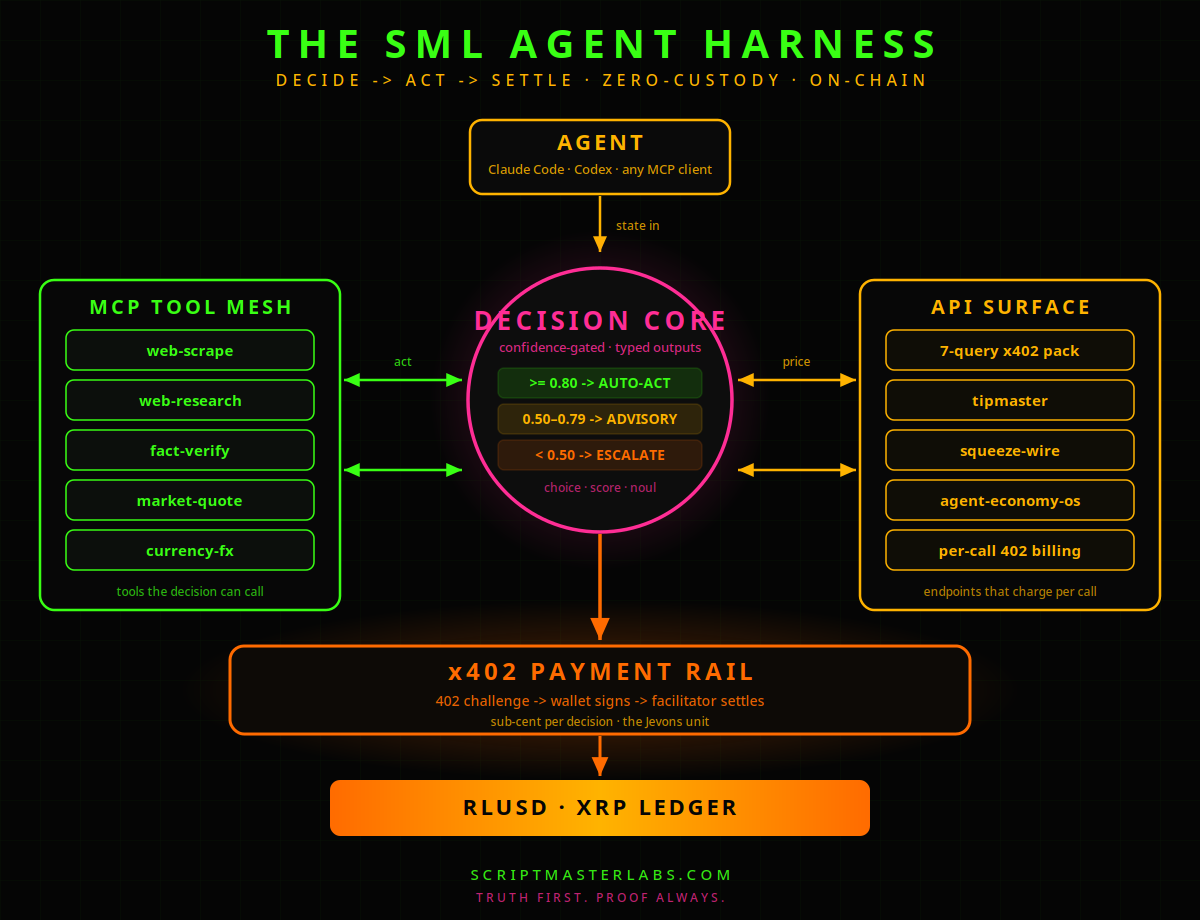
Jev's killer feature isn't speed. It's calibrated confidence — a number your code can branch on. That maps directly onto payment authorization:
| Confidence | Decision posture | Payment posture |
|---|---|---|
| ≥ 0.80 | Auto-act, no human in the loop | Auto-approve micro-payment (x402) |
| 0.50 – 0.79 | Advisory — show a human the evidence | Hold in escrow / request approval |
| < 0.50 | Escalate and log | Block payment, alert |
// the agent-economy loop: decide, then settle
const call = await jev.decide(state, [
  { id: "payout_ok", type: "noul",
    question: "Should this bounty be paid out?" }
]);

const c = call.payout_ok.confidence;
if (c >= 0.80)      await x402.pay(bounty.invoice);   // auto-settle
else if (c >= 0.50) await escrow.hold(bounty);        // human review
else                   await alert.escalate(call);       // block + log
This is the decision layer meeting the transaction layer. Jev decides; x402 pays. Neither works as an economy without the other: cheap decisions with no way to settle value are just opinions, and programmable money with no judgment authorizing it is just a wallet.
Jev exploded because it made machine judgment cheap. The Jevons paradox says the next explosion is volume: millions of agent decisions a day, each one a potential transaction. The builders who win that wave won't just be the ones with the cheapest decisions — they'll be the ones whose agents can act on them with money. That's the layer we're building.
Truth First. Proof Always. — ScriptMasterLabs